
 Top of Part 3
 Last page
 Next page
|
Top of Part 3
Last page
Next page
|
3-2: The Structure of Hydrogen Atom |
As mentioned before,
it is considered that
there is a heavy
proton at the center of
a hydrogen atom
and a light electron
revolves around it.
The proton may be thought
to be approximately
at rest at the origin
of the coordinate
(the center of the
hydrogen atom)
because proton is
about 1800 times heavier
than electron.
The Coulomb attractive force
works between the proton
and the electron.
Its potential is written
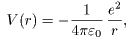 where r
is the distance between
the proton and the electron.
The Schroedinger equation
describing the motion
of the electron is
given by
where r
is the distance between
the proton and the electron.
The Schroedinger equation
describing the motion
of the electron is
given by
 Needless to say,
the wave function
Needless to say,
the wave function
 is a function
of
x ,
y
and
z .
is a function
of
x ,
y
and
z .
|
[The Eigenstates of Hydrogen Atom]
In the present case,
the polar coordinate
 shown in the following
Fig. (A)
is more convenient than
the Cartesian coordinate
shown in the following
Fig. (A)
is more convenient than
the Cartesian coordinate
 . .
 We solve
the Schroedinger equation
(1) represented
in the polar coordinate
setting the boundary condition
that the wave function
should be smoothly continuous
at every point of
the coordinate space
and should converge to 0
at the infinitely long distance
We solve
the Schroedinger equation
(1) represented
in the polar coordinate
setting the boundary condition
that the wave function
should be smoothly continuous
at every point of
the coordinate space
and should converge to 0
at the infinitely long distance
 .
Then we have
a set of discrete
energy eigenvalues
and the corresponding eigenstates.
The details of
the method to solve it is
omitted here.
If you want to study them,
please refer to some
other textbooks
of quantum mechanics.
The wave functions
of the eigenstates
is expressed as .
Then we have
a set of discrete
energy eigenvalues
and the corresponding eigenstates.
The details of
the method to solve it is
omitted here.
If you want to study them,
please refer to some
other textbooks
of quantum mechanics.
The wave functions
of the eigenstates
is expressed as
 Here the part
 is called the
radial wave function
which is specified
by a set of integers,
n
and
l .
Such numbers (integers) as these
n
and
l
are sometimes called
quantum numbers,
which characterize
the eigenstates.
In the present case, they are
is called the
radial wave function
which is specified
by a set of integers,
n
and
l .
Such numbers (integers) as these
n
and
l
are sometimes called
quantum numbers,
which characterize
the eigenstates.
In the present case, they are
 The part
 denotes the angular
wave function
which is specified
by a set of quantum
numbers (integers),
l
and
m , and
they are given by
denotes the angular
wave function
which is specified
by a set of quantum
numbers (integers),
l
and
m , and
they are given by
 The angular wave function
describes the revolving state
of the electron around
the coordinate origin (proton).
Namely,
the quantum number
l
expresses the speed
of the revolution of
the electron,
i.e. the magnitude of
the angular momentum
of the electron, and
m
represents
the orientation (direction)
of angular momentum vector.
The fact that these quantum numbers
l
and
m
are integers
means that
both the magnitude
and
the orientation
of the angular momentum
are step-like and discrete.
This result implies that
not only energy but also
angular momentum
and its orientation
are quantized
in quantum mechanics.
This was confirmed
by the Stern-Gerlach experiment
(1922).
Needless to say,
this also originates
from the particle-wave
duality of electrons.
And this can never understood
by the classical theory.
The angular wave function
describes the revolving state
of the electron around
the coordinate origin (proton).
Namely,
the quantum number
l
expresses the speed
of the revolution of
the electron,
i.e. the magnitude of
the angular momentum
of the electron, and
m
represents
the orientation (direction)
of angular momentum vector.
The fact that these quantum numbers
l
and
m
are integers
means that
both the magnitude
and
the orientation
of the angular momentum
are step-like and discrete.
This result implies that
not only energy but also
angular momentum
and its orientation
are quantized
in quantum mechanics.
This was confirmed
by the Stern-Gerlach experiment
(1922).
Needless to say,
this also originates
from the particle-wave
duality of electrons.
And this can never understood
by the classical theory.
|
[The Energy Eigenvalues of Hydrogen Atom]
The energy eigenvalues
of hydrogen atom
are determined
only by the quantum number
n
and they are
expressed as
 The state with n
= 1
is the lowest energy state
(the ground state)
and those with
n
= 2, 3, ...
are the excited states.
Thus the ground-state energy
is written
The state with n
= 1
is the lowest energy state
(the ground state)
and those with
n
= 2, 3, ...
are the excited states.
Thus the ground-state energy
is written
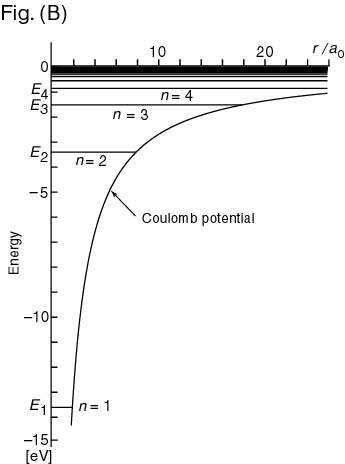
 The energy eigenvalues
(energy levels)
are shown in the following
Fig. (B),
in which
the heights of the
horizontal lines (levels)
show the energy
eigenvalues obtained
by solving the Schroedinger equation
(1).
The energy eigenvalues
(energy levels)
are shown in the following
Fig. (B),
in which
the heights of the
horizontal lines (levels)
show the energy
eigenvalues obtained
by solving the Schroedinger equation
(1).
|
|
Fig. (B): The energy eigenvalues
of hydrogen atom
The abscissa denotes
the position coordinate
of the electron
(the distance between
the proton and electron),
r ,
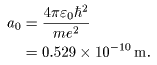
in units of the
Bohr radius
 ,
where ,
where
|
[The Probability
that Electron will be Found]
It is very interesting
to see how much
the probability
for a electron to be found
at a point in the space is.
The probability density
 at a position of the distance
r
from the center
is shown in
Fig. (C).
Integrating this probability density
over the whole space, we have
at a position of the distance
r
from the center
is shown in
Fig. (C).
Integrating this probability density
over the whole space, we have
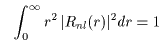 As shown in this integration,
the present wave functions
are so normalized
that the total
probability would be 1
(= 100 %).
As shown in this integration,
the present wave functions
are so normalized
that the total
probability would be 1
(= 100 %).
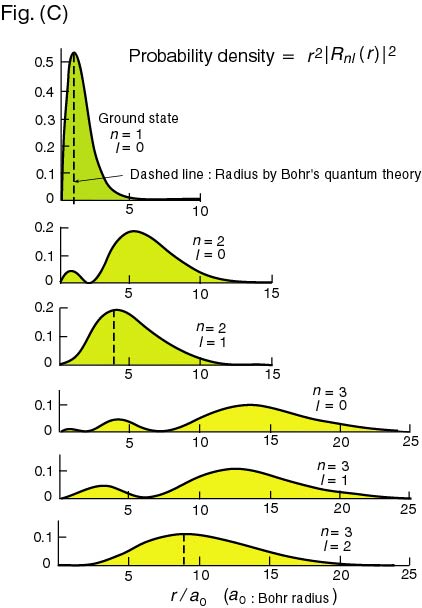 The above Fig. (C) shows
the probability distribution
of electron in hydrogen atom.
The first figure
shows the ground state,
in which
almost all probability
concentrated
at
The above Fig. (C) shows
the probability distribution
of electron in hydrogen atom.
The first figure
shows the ground state,
in which
almost all probability
concentrated
at
 We can therefore consider
that the true radius
of a hydrogen atom is
almost equal to
the Bohr radius
.
However, in the excited states,
the probability is
widely extended
at the distant area,
so that the excited
hydrogen atom
would be rather swollen.
We can therefore consider
that the true radius
of a hydrogen atom is
almost equal to
the Bohr radius
.
However, in the excited states,
the probability is
widely extended
at the distant area,
so that the excited
hydrogen atom
would be rather swollen.
|
|
[Conclusion of This Page]
We have studied
how the solutions
of the Schroedinger equation
for the case of hydrogen atom are.
All of Bohr's quantum theory
are completely included
in the solutions.
This means that
all the structure
of hydrogen atom
can perfectly be derived
just from the single equation,
the Schroedinger equation.
Thus we can understand
how splendid and how fundamental
the theory of Quantum Mechanics is.
|
 Top
Top
|
|
|
Go back to
the top page of Part 3.
Go back to
the last page.
Go to
the next page.
|