
 Top of Part 3
 Last page
 Next page
|
Top of Part 3
Last page
Next page
|
3-3: Nuclear Fission |
On the previous page:
3-1:The Origin of the Nuclear Energy,
the fission of uranium-235
(
 )
was taken up as an example
of nuclear exothermic reaction,
in which a huge amount of energy
is released when neutrons
being bomberded against uranium-235
nuclei to split them into
several fragments.
One of the equations for these fission
processes is written as )
was taken up as an example
of nuclear exothermic reaction,
in which a huge amount of energy
is released when neutrons
being bomberded against uranium-235
nuclei to split them into
several fragments.
One of the equations for these fission
processes is written as
 Here
Q
is the released energy
which is more than
200 MeV per one process.
"2n" on the right-hand side
means that two neutrons
are simultaneously emitted.
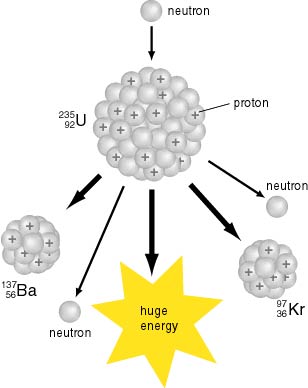
A schematic sketch
of this fission process
is drawn as the following figure.
Here
Q
is the released energy
which is more than
200 MeV per one process.
"2n" on the right-hand side
means that two neutrons
are simultaneously emitted.
A schematic sketch
of this fission process
is drawn as the following figure.
|
|
[Schematic Drawing of the Fission
Process of Uranium-235]
When neutrons are bombarded
against uanium-235,
the uranium-235 nucleus absorbs
a neutron to be a uranium-236
and it
splits into
two fragments of almost equal
masses
with emitting
some neutrons simultaneously
and evolving
a huge amount of energy
larger than 200 MeV.
This is nothing but
one of the examples
of fission of uranium-235.
It does not always
split into Ba and Kr
but usually into two fragments
with almost equal masses.
The number of emitted neutrons
is also not always constant
but it distributes over one
to several.
Then the emitted energy is
not always constant
but is almost 200 MeV.
|
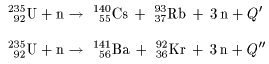
The above equation is
one of the examples
of fission of uranium-235.
There are many other processes
of which examples are
as follows:
|
|
[The Discovery of Nuclear Fission]
Rutherford
carried out alpha-particle
scattering experiments
by bombarding the alpha rays
emerging from radioactive Polonium (Po)
or Radium (Ra) elements
onto various nuclei.
Thereby he succeeded
in the first
artificial transmutation of elements (1919).
Since then, experiments
of alpha-particle scattering
on nuclei
had been repeated extensively.
Chadwick investigated
the mysterious penetrating radiation
emitted from a beryllium (Be) target
which is bombarded by
high-energy alpha particles
from a Po source.
Finally he concluded
that this mysterious radiation is
a neutral particle
with protonic mass.
This was
the discovery of neutron
(1932).
O. Hahn
(Germany, 1879 - 1968) and
F. Strassmann
(Germany, 1902 - 68)
carried out the experiments
to bombard neutrons
from (Po-Be) source
against uranium.
They observed an important
phenomenon in which
the uranium nucleus
bombarded by neutrons
splits into two large
fragments.
Among the reaction products,
they found
Barium (Z = 56)
and Lanthanum
(Z = 57).
L. Meitner
(Germany, 1878 - 1968),
a former collaborator of Hahn,
and her nephew
O. R. Frisch,
who had fled to Sweden
from Nazi Germany,
were reported these experimental results
by a letter.
They analyzed these results
and immediately recognized
the significance.
They were convinced that
the experimental results
are due to
the neutron-induced
nuclear fission
and they published this idea.
This was the first
discovery of nuclear fission.
|
|
[The Mechanism of Nuclear Fission]
As explained on the page:
3-1: The Origin of the Nuclear Energy,
if such a heavy nucleus
as uranium-235
splits into two fragments
of almost equal mass,
each of them would be bound more
tightly than the original nucleus.
In that case, an energy excess
is brought about
and the state after the reaction
becomes more favorable
than before the reaction.
Accordingly,
a heavy nucleus has
always a possibility of
nuclear fission.
Using the idea of
Liquid Drop Model,
let us explain
in what mechanism
such a heavy nucleus
as uranium-235 fission.
The nucleus is
a many-nucleon system
consisting of protons and neutrons.
It can be assumed to be
something like
a drop of water
or a raindrop.
A heavy nucleus
is therefore considered to be
very "soft" and "flabby"
and easy to deform.
However, since a strong nuclear force
works between nucleons
and it plays a role of
surface tension,
the ground state of a nucleus
is rather stable
and does not directly fission.
If some amount of energy is given
to a nucleus to be
in an exited state,
then it easily deforms
and fissions.
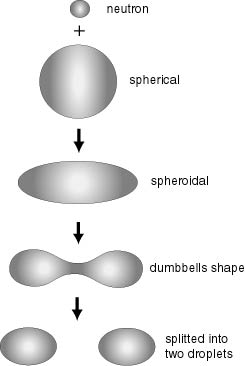
You would be able to understand
the fissioning mechanism
by the
following two figures.
|
|
[Fission Mechanism by Liquid Drop Model]
If such a heavy nucleus
as uranium-235
absorbs a neutron,
it is in an excited state.
The soft nucleus is easy
to deform.
Sometimes it becomes
dumbbells shape
and splits into
two droplets.
At that time
the energy excess
is released.
|

|
[Schematic Graph of Energy in Nuclear Fission]
This diagram schematically shows
the potential energy for nuclear fission
as a function of
the degree of nuclear deformation
or the average separation
of the two fission fragments.
The ground state of the nucleus
is confined within the valley
of potential barrier
and is stable.
When it is excited
to be close to
the top of the barrier,
it penetrates the barrier
with the
tunnel effect
and run down along the potential
slope to fission.
|
|
[The Chain Reaction]
As shown in the equation at
the top of this page,
the fission of a uranium-235
is accompanied by the emission
of neutrons.
There are several types of
fission processes
in the uranium-235 fission,
in each of which one, two or three
neutrons are emitted;
on average, 2.5 neutrons
are released.
These neutrons are capable to
cause further fission
of uranium-235.
If each fission causes
an average of more
than one further fission,
an avalanche of fission reactions
will result.
This is called
the chain reaction.
As soon as Hahn and Strassmann
discovered nuclear fission,
many physicists
noticed the possibility
of the chain reaction.
If the chain reaction
occurs very rapidly
in an uncontrolled way,
a violent explosion follows.
Then it can be used for a military
purpose; i.e. an atomic
or strictly speaking a nuclear
bomb.
If the chain reaction
is well controlled,
then it can be used
as a power source.
The first experiment
of nuclear chain reaction
was carried out
in 1942
by E. Fermi
(Italy, USA, 1901 - 54),
who had fled to US
from Fascists Italy,
and his colleagues.
|
|
[Nuclear Reactor]
A device in which controlled nuclear
fission takes place
to produce heat or energy
is called a nuclear reactor.
It is the main facility
of a nuclear power station.
The first nuclear reactor
was constructed
by Fermi
and coworkers
at the University of Chicago
in 1942.
|
[Other Kinds of Fissionable Materials]
An elemental isotope that undergoes
induced fission
when being struck by a free neutron
is usually called "fissionable".
Of course, the most popular
fissionable material
is uranium-235
().
One of the other
well-known fissionable
materials is
pultonium-239
( ),
which is usually produced
in a reactor
from uranium-238.
(Uranium-238 is not
fissionable, so that
it does not "burn"
in a reactor.)
While almost all pultonium
is artificially produced,
extremely tiny amount
is found naturally.
Another kind of
element
that can be used
as a nuclear fuel
in reactors
is thorium,
which occurs naturally. ),
which is usually produced
in a reactor
from uranium-238.
(Uranium-238 is not
fissionable, so that
it does not "burn"
in a reactor.)
While almost all pultonium
is artificially produced,
extremely tiny amount
is found naturally.
Another kind of
element
that can be used
as a nuclear fuel
in reactors
is thorium,
which occurs naturally.
|
 Top
Top
|
|
|
Go back to
the top page of Part 3.
Go back to
the last page.
Go to
the next page.
|